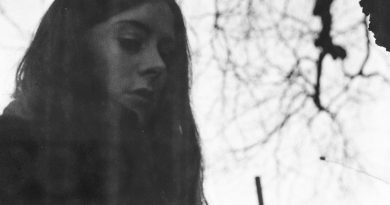
A Chat with Natisa Gogol (08.07.25)
Ukrainian singer-songwriter Natisa Gogol returns with a powerful and soul-stirring new single, ‘Matrix’ – a bold artistic statement that delves into the struggle for authenticity in a world of illusion. Teaming up with director Farid Alijanov, Gogol brings the song to life in a visually arresting, one-woman music video that mirrors the emotional journey at its core, one of inner conflict, awakening, and liberation. We chat with Natisa Gogol to discuss the inspiration behind ‘Matrix’, the creative process, and what it means to find one’s voice in a world that demands masks.
OSR: ‘Matrix’ feels incredibly personal. Can you take us back to the moment or experience that first sparked the idea for this song?
Gogol: So, the idea of the ‘Matrix’ theme in my song came from my own perception of myself in this world, from how I see and feel my place in this reality. It’s like a sense that we’re living in a system, almost a simulation, an incredibly sophisticated program where everything has a beginning and an end. This feeling was reinforced by moments of déjà vu in my life, when objects seemed to move or appear in different places, or when I’d meet people and feel like I’ve known them forever, even though it’s the first time we’ve met. These experiences created the impression that we’re all part of this intelligent system called the Matrix. And I’d also add that this sense of reality being multivariant, with parallel realities intersecting or diverging, further supports the theory that we’re living in some sort of simulation or program.
OSR: You described writing ‘Matrix’ as an act of liberation. What were you freeing yourself from?
Gogol: When I wrote this song, it was like an inner monologue – a conversation with myself that I wanted to share with people around the world. Through this piece, I was trying to understand who I am within this system, within this life, and whether I can break through the limits of what we usually perceive, the boundaries of our three dimensions of space and one dimension of time. I’m curious if there is something beyond that perception – something that exists outside the framework we’re used to.
OSR: The song references the metaphor of the Matrix. How has that concept influenced your life beyond this track?
Gogol: After the release of the song ‘Matrix’ on all music platforms, I didn’t expect my life to change dramatically or suddenly. In reality, it was a slow and gradual shift in my perception. Even before writing the song, I felt that there was something important I needed to express. It was like an idea that matured step by step, inspiring and motivating me as it grew. This transition was smooth yet constant, a cumulative realisation that the limits we set for ourselves in life, especially when it comes to human potential, willpower, and the strength of our thoughts, intentions, and desires, are just constructs. Society’s rules and frameworks, while necessary, often hold back the true power of the individual spirit and character, preventing us from fully realizing just how limitless we are. With ‘Matrix’, I wanted to show that we must explore and understand ourselves on a deeper level because we are so much more than we think. These boundaries are not absolute; we can transcend them, not necessarily in the physical world, but on another plane. I’m referring not only to spirituality, mysticism, or esotericism but also to scientific concepts, like quantum leaps and quantum physics. We are truly greater than the limits we often impose on ourselves.
OSR: What was it like incorporating Chopin’s ‘Fantaisie-Impromptu’ into the song? Was that always part of the plan?
Gogol: I didn’t choose Chopin’s ‘Fantaisie-Impromptu’ by accident – it’s a piece from my childhood and the most beautiful one I ever played in music school. My beloved piano teacher, Pletner Olga, inspired my deep love for music, and I always dreamed of including this masterpiece in my own work, though I never knew how to blend classical music with pop. When the idea for ‘Matrix’ came to me, I realized it was the perfect moment to combine the unexpected and bring new depth to my sound. I played all the piano parts myself, fulfilling a dream I had for years. It’s such a joy to see your dreams come to life, especially in art.
OSR: How did your classical music background shape your approach to songwriting today?
Gogol: Classical music has significantly enriched my musical horizons and allowed me to delve deeper into the very essence of music – its origins, its harmony, and its incredible depth. It has deepened my perception of music, and I gladly draw inspiration from it. It’s an inexhaustible source of ideas, and I believe that bringing elements of classical music into contemporary music is a wonderful thing. When I have the opportunity, I embrace it with joy. Although I don’t do it very often, my classical training has truly broadened my musical perspective. Even though music constantly evolves and changes, classical music remains timeless and always relevant.
OSR: The production is stripped-back but incredibly powerful. Why did you choose such a minimal arrangement?
Gogol: The arrangement was chosen to be minimalistic in order to highlight Chopin’s piano parts and to emphasise the lyrics and the message of the song. As a result, the arrangement has a bit of an ’80s vibe, with a certain lightness and simplicity, so as not to complicate the listening experience. After all, the concept, the lyrics, and the inclusion of a classical piece already carry deep meaning, and the goal was to keep it all as accessible and easy to perceive as possible.
OSR: You performed all the piano parts yourself. How does that creative control shape the emotional delivery?
Gogol: When I take a more active role in the arrangement process, it always means a deeper and more emotional involvement for me, especially when I’m performing certain parts myself. Naturally, I want everything to turn out as beautifully and as high-quality as possible, to really create that “wow” effect. There’s often a sense of perfectionism, and I keep feeling like things can always be made even better. But in the end, I was quite satisfied with the result, and I can honestly say that it’s wonderful to be so fully immersed in the process.
OSR: What artists, musical, visual, or literary, have influenced your current phase of creativity?
Gogol: I can’t really name specific individuals who influence me, whether artists, literary characters, or anyone else. It’s always a blend of collective images and inspiring situations, not just people. It can be experiences, whether lived or imagined, that feel as real as any memory. It’s my own reflections and conclusions. I’m always inspired by one thing only: love. There are no specific people, characters, or anything like that. I’m inspired solely by love, that all-encompassing, all-permeating energy: love for God, love for people, love for life, love for oneself, and love for the world. Everything is connected to that.
OSR: What message do you hope listeners walk away with after hearing this song?
Gogol: I understand that each listener will discover their own meaning in this song. My message is based on my personal experience and worldview, but I know that everyone will interpret it in their own way: some may see a global idea, while others might take it as a personal challenge. My hope is to inspire the listener to look beyond the ordinary and not be afraid of discovering something new. Ultimately, what matters to me is that the song touches each person in their own unique way.
OSR: If you could have one listener truly understand one line in the song, which would it be, and why?
Gogol: If a listener could take away just one line from my song, it would probably be: “Can I get out of the matrix?” – the matrix of our beliefs, our prejudices, our fears, the traps of the mind, and the social stereotypes and constraints that prevent us from fully knowing ourselves and opening up to the world. This is what I’d love people to reflect on: whether they can step out of the matrix of their everyday routines and understand something deeper about why we live and what it all means. That, I think, would be the main idea I’d love for them to take away from the song.
Many thanks to Natisa Gogol for speaking with us. Find out more about Natisa Gogol on her Facebook, Instagram, TikTok, and Spotify.